"We can no longer work on docks and cut up trees."
That line came from a shoreline engineer speaking at a Van Buren Township meeting about the Belleville Lake ordinance, as reported by the Belleville Independent. He'd lived on West Huron River Drive long enough to remember when Detroit Edison still owned the lake and residents could lower the water level each fall to work on their own docks. He wasn't describing a hypothetical. He was describing what happens when a homeowner discovers that the water outside their back door belongs to someone else.
Anyone shopping Belleville Lake waterfront right now should sit with that for a minute, because it points to something the listing photos never explain. A house on Belleville Lake is not attached to a natural lake in the way a house on most Michigan lakes is. It sits next to a hydroelectric impoundment, and the rules that come with an impoundment are different from the rules everyone assumes apply to lakefront property.
An Impoundment, Not a Natural Lake
Belleville Lake exists because a dam was built. The Township's own description of the lake states plainly that traditional riparian rights do not apply here, because Belleville Lake is an impoundment rather than a natural body of water. That single sentence is the whole story in miniature. Riparian rights are the legal doctrine that lets a natural lakefront owner treat the water's edge as an extension of their property. An impoundment doesn't automatically carry that doctrine, because the water itself is a byproduct of infrastructure, not geography.
Detroit Edison built the dam and, in 1972, offered ownership of it along with the surrounding properties to Van Buren Township. Township voters approved the transfer, and ownership of that shoreline has belonged to the Township ever since. The Township now holds a federal license, FERC No. 9951-000-Michigan, for what's known as the French Landing Hydroelectric Project, and that license is what governs the seven-mile, roughly 1,270-acre lake today.
Where Your Property Ends and the Township's Begins
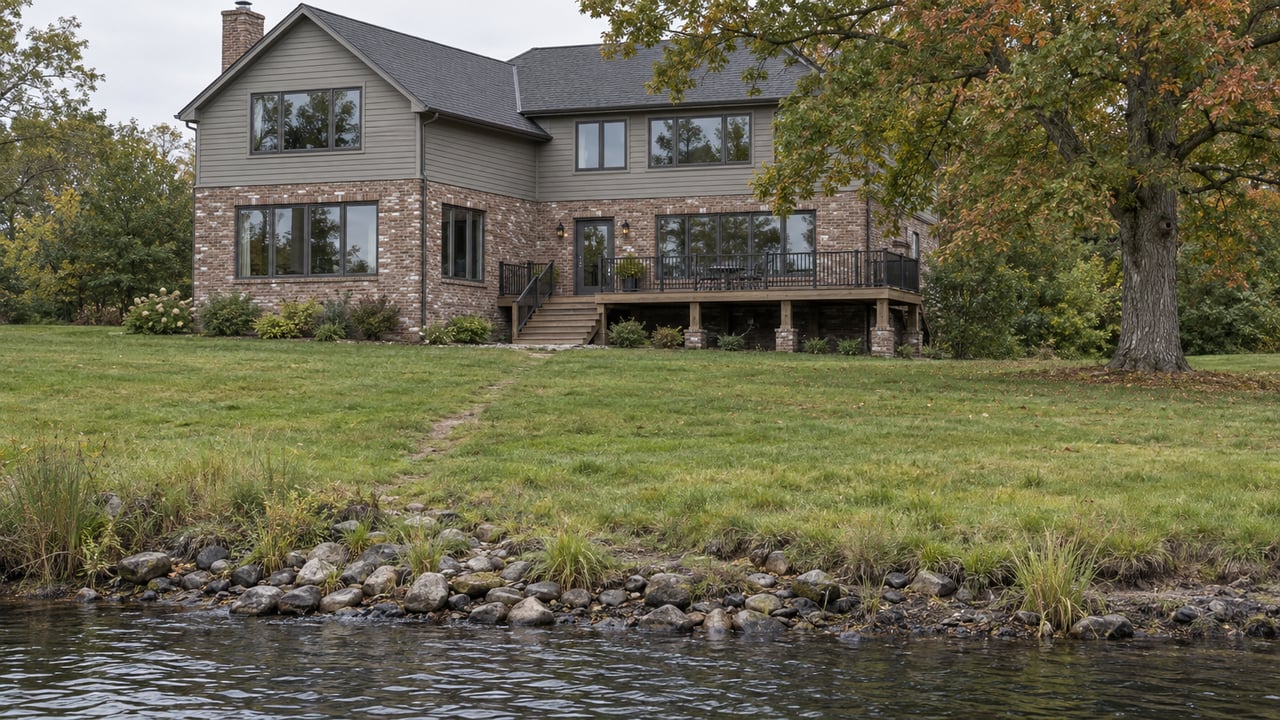
The practical boundary is a specific elevation: the 655-foot contour line, sometimes described as the brow of the hill. Everything below that line, according to the Township, belongs to Van Buren Township, not to the adjacent homeowner. A house can sit right up against the water and still not own the strip of shoreline between the yard and the lake.
That distinction matters most at the point where a buyer starts picturing their own dock, their own boat hoist, their own private stretch of beach. Under the license, none of that is automatic. The Township's language is direct: no improvement, modification, or structure of any kind, including docks, boat hoists, boathouses, boardwalks, piers, seawalls, decks, or stairs, may be built on that township-owned strip without first requesting permission.
This is worth sitting with for a second time. A buyer closing on a Belleville Lake home isn't just buying a house with water access. They're buying a house next to land the Township controls, under a federal license that exists to protect the scenic, recreational, and environmental values of the hydroelectric project, not to guarantee private recreational structures to every adjacent owner.
The Permission Slip Behind Every Dock
The same public meeting that produced the dock quote also produced a more pointed illustration of what "you don't own the shoreline" means in practice. An attorney who had served on the ordinance committee explained that homeowners did not have exclusive use of the land between their house and the water. He offered a blunt example: someone could come up by boat, set up a tent and a hibachi on that strip, and stay overnight, and it would not be illegal. The point of the ordinance discussion at that meeting was to change that by giving shoreline residents exclusive use of the land in front of their own homes. Whatever became of that specific vote, the underlying default the attorney described, that the strip belongs to the public until a rule says otherwise, is still how the Township describes its own authority over that land today.
For a buyer, the takeaway isn't that strangers are likely to camp on your beach. It's that the presumption of privacy a natural lakefront owner takes for granted doesn't automatically exist here. Anything that looks like a private amenity, a dock, a seawall, a boat hoist, is really a permission the Township has granted, and permissions can be conditioned, questioned, or in theory withheld.
A Program Still Being Paid For, One Year at a Time
There's a second layer to this that has nothing to do with docks and everything to do with cost, and it's happening right now. Van Buren Township, working with an environmental consultant called Progressive Companies, has spent the past year running a Belleville Lake Water Assessment Project. A community meeting on October 15, 2025 introduced the assessment and gathered resident concerns. A second meeting on April 30, 2026 reviewed the completed limnology findings and, notably, opened a conversation about potential funding options to keep the program running.
That phrase, funding options, is doing real work. The Township has covered aquatic weed control and phosphorus inactivation treatment for this first year. Contractors PLM Lake & Land Management Corp and Aqua Weed Control Inc. have been treating the lake through the summer of 2026, targeting invasive Eurasian milfoil and applying a lanthanum-based phosphorus binder, with a treatment near Rawsonville Road and Lake Pointe Pass completed June 10 and a second round scheduled for July 13. The Township's own materials explain why phosphorus is the target: it's the limiting nutrient in a lake like this, and by their account, a single pound of phosphorus can produce 500 pounds of algae.
None of that is alarming on its own. Lake management is normal, and a township funding a limnology study is a sign of attentiveness, not neglect. But a first year funded by the Township with an open question about what funds year two is exactly the kind of detail a buyer should have on their radar before closing, not after a special assessment notice arrives in the mail.
What to Ask Before You Make an Offer
None of this means Belleville Lake waterfront is a bad purchase. It means the due diligence looks different than it would on a natural lake, and a few specific questions belong on every offer conversation:
- Does the home have an existing dock, seawall, or boat hoist, and if so, is there documentation that it was permitted by Van Buren Township rather than simply built at some point in the past?
- Has the seller applied for or received permission for any shoreline structure in recent years, and how long did that process take?
- Is the property within the current or a past aquatic treatment zone, and if so, what water use restrictions have applied historically during treatment windows?
- Has the Township signaled any timeline for how the lake assessment program will be funded beyond its first year?
A seller who can answer these clearly is signaling exactly the kind of ownership experience a buyer wants: someone who has actually lived with the Township's permission process rather than assumed it away.
Does this apply to every house that touches Belleville Lake? Yes, in the sense that the contour-line ownership and the FERC license apply lake-wide. What varies is whether a given property already has a permitted structure in place or whether a buyer would be starting that process from scratch.
What if the dock is already there when I buy the house? An existing structure doesn't retroactively answer whether it was properly permitted. That's worth confirming during due diligence rather than assuming continuity of use settles the question.
A Belleville Lake address still means what everyone hopes it means: water out the back window, a boat within reach, summer evenings that don't require a drive. It just comes with a landlord for the shoreline itself, and knowing that before the offer is written is what keeps the dream from arriving with a permit application attached.
If you're weighing a Belleville Lake purchase or getting ready to sell one, Stephen Hollowell can walk through what a specific property's shoreline history actually looks like before you write the offer. Schedule a free consultation to start that conversation.